
Agrivoltaics in Italy
Foreign investors usually meet the word agrivoltaico late, when a site they liked turns out to be classified as farmland. It is not a marketing label for a solar farm with sheep under it. In Italy it is a distinct category with its own rules, and in many cases it is the only route a piece of agricultural land has.
What it is
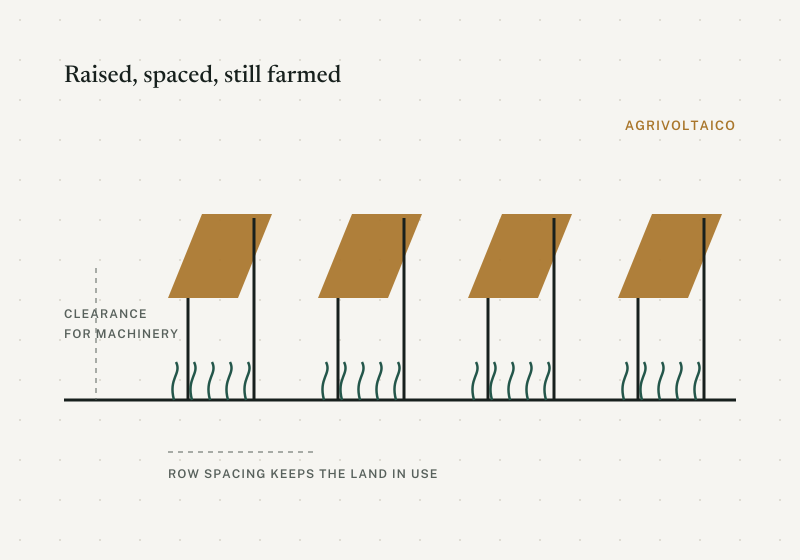
Modules raised on posts or spaced in rows, so that the ground underneath stays in agricultural use rather than being covered over. Farming continues; generation happens above and between it.
The design consequences are real: higher structures, wider row spacing, access for machinery, and monitoring to show the land is still farmed. All of it costs more per megawatt than a conventional ground-mount plant, and all of it is the reason the plant is allowed to exist at all.
Why it matters more in Italy than elsewhere
Italian law restricts the installation of ground-mounted photovoltaic modules on land classified as agricultural, with exceptions, and the Constitutional Court confirmed that approach in 2026. The practical effect for a buyer is blunt: a field that would carry a conventional plant in Spain or Germany may not carry one here.
Agrivoltaics is one of the routes that remains open on that land, which is why so much of the Italian pipeline is described that way. It also carries its own requirements, and a project that calls itself agrivoltaic without meeting them is not one.
These rules have changed repeatedly and are still being tested in the courts. What applies to a specific parcel is established by the appointed technical firm looking at that parcel, not by any website — this one included.
What to ask before you get interested
- How is the land classified, and what does the town-planning certificate actually say about it.
- Which agricultural activity continues, who carries it out, and under what agreement with the landowner.
- What the layout implies for module height, row spacing and access, and therefore for capacity on that surface.
- How the continuation of farming is evidenced and monitored over the life of the plant.
- Which authorisation route applies, and whether any environmental assessment is triggered.
- What the connection point can carry, because none of the above matters if the grid cannot take the output.
As at September 2026. This page is general information about how agrivoltaic projects are treated in Italy, not legal, technical or investment advice, and it is not an offer to sell or a solicitation to buy any security, financial instrument or participation. Italian rules on agrivoltaics, suitable areas and ground-mounted plants on agricultural land change frequently: verify the position applying to a specific site with the professionals appointed for it.
Questions we are asked first
Is agrivoltaics just a way around the rules?
No, and treating it that way is how projects fail. The farming has to be real and has to continue, which shapes the layout, the cost and the obligations that come with the plant.
Does it produce less than a conventional plant on the same land?
Generally yes per hectare, because the modules are spaced and raised. Whether that trade-off works is a question for the technical study on the specific site, not for a general rule.
Can you find agrivoltaic sites?
We introduce investors to the Italian firms that assess and develop them, and we look at land from one hectare upwards. The sequence is the same as for any other technology.
Have a site classified as agricultural?
Tell us where it is and how big it is. The first answer you get will be whether it is worth pursuing at all.